California Ammo Laws

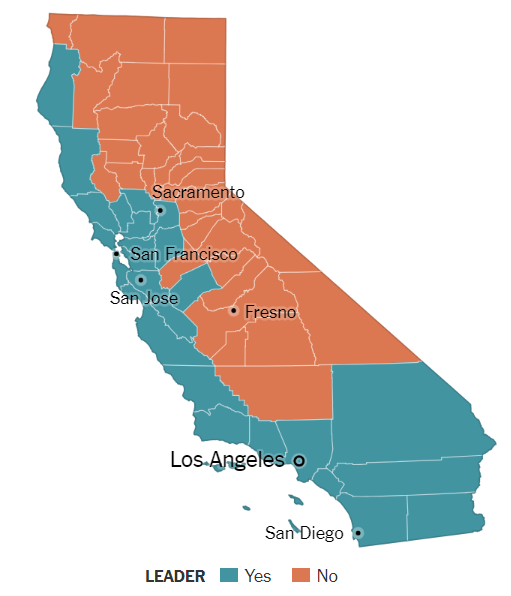
A couple of interesting gun-related statutes, which I’m just now learning about, are taking effect this July 1st, 2019. Proposition 63, which originally went to vote in 2017, had called for a background check on anyone purchasing ammunition in CA, as well as a ban on large-capacity magazines (which was later ruled unconstitutional) and passed 63.1% to 36.9%. Now, Prop 63 will just require the background check for ammo sales. Here’s an interesting visual of how CA voters were split on the original prop:


Source: Election results from The Associated Press
By The New York Times

It’s not surprising that the opposition consisted of mostly rural counties that hold large undeveloped natural spaces where, coincidentally, according to a survey of deer hunters by the CDFW in 2015, a big percentage of deer hunters reside. I did notice in the survey that a major portion of deer hunters also lived in LA and Humboldt counties; both of which supported the proposition, but have relatively fewer hunters compared to their greater county populations.

Another bill, AB-711, which passed in 2013, will also take effect this July. 711 requires the use of non-lead ammunition when taking any wildlife with a firearm in California. The ban on toxic ammo in hunting first began nationwide in 1991, and only applied to waterfowl when it was found that lead shot had adverse effects on the environment and impacted wildlife that may have somehow consumed the shot. And according to the Institute of Wildlife Studies’ website on non-lead hunting, it’s also been discovered that lead rifle bullets can fragment and potentially impact surrounding wildlife. This new ban would now extend to non-waterfowl hunters, who would need to swap out their existing munitions and purchase non-lead ammo which can often be more expensive.

I don’t mind these new laws if it means a healthier environment and safer society, however I can see how they add extra steps and costs which add to the already high barrier of entry for new hunters.

The Costs of a New Hunter

One of the most prohibitive barriers I’ve encountered as a new hunter is the cost of entry into the sport. Firearms and their accessories are at the top of the list, but a number of smaller items like clothing, gear, courses, certificates, and licenses can add up. Costs can vary depending on where and what you hunt, but regardless of quarry, if you’re completely new like me, you can probably expect a dollar range in the high hundreds to low thousands just to get started. To help get an idea of the overall cost, I’ll run through typical hunting-related expenses I’ve paid, or plan to pay.

Firearms

If you’ve seen my last post on firearms, you’ll know there are a few big-ticket items needed just to own a gun. Let’s assume you want to hunt ducks in CA like me, and don’t plan to get more than one firearm. That means you’ll need to buy an appropriate shotgun. On the low end, a very basic pump-action shotgun (like a Remington 870) could get the job done, and will cost on average about $330 before taxes and fees. But I have a little more saved up, and want a higher-performing gun, so I plan to purchase a Benelli M2 with a camo pattern, which I estimate to cost around $1,400 before taxes and fees.

You’ll then want a DOJ-approved safe to store that new shotgun. A Google and Amazon search showed I could get an entry-level, low-capacity (less than 10 guns) starter safe for about $200, but I start to question the quality of options at that price point. I’d rather not gamble with gun safety, so I went with the Winchester TS-9 10 Gun safe for a total of $550 after delivery and taxes. If you want features like fingerprint scanning or fire/water resistance, expect to pay a premium. For added safety, it’s advised to have a separate smaller safe to store your ammo away from your gun. I found a decent safe on Amazon for $150 for just this purpose.

Then you’ll need to get the actual ammunition (see Updates). I still don’t know as much as I’d like about guns and ammunition, but in California, it’s illegal to use lead ammunition for hunting, so let’s suppose we’ll be shooting standard 3″ 12 gauge steel loads. On a few sporting goods sites, it looks like I could get a cheap box of 25 shells for about $16. But how much ammunition would I actually need on a hunt? According to CDFW, I’m allowed a daily bag limit of 7 ducks during the season, so if I’m hunting two days over the weekend, the very minimum I’d want to have is 14 shells. Realistically I’d probably want at least 2-3 times that since I’m new to shooting and will probably miss a ton. I’m guessing that maybe one box of 25 shells for each day of duck hunting would be sufficient. I have no idea if this logic is correct, but it sounds reasonable in my head. I’ll probably want to stock up on extra ammunition too, so I don’t have to run down to San Jose every time I need ammo. To be safe, I’ll aim have 4 boxes just for hunting.

This is step optional but it’s a good idea to at least test the gun at a range and get the correct shot spread dialed-in prior to the actual hunt. The closest public shotgun range to me is the Coyote Valley Sporting Clay range down in Morgan Hill. I went there once for a birthday and spent maybe two hours learning how to handle and shoot a shotgun, probably shooting about 100 clay targets in total. Pricing on the site shows a cost of $0.44 per target, or $44 total for an average session. And don’t forget the additional 100 shells (4 boxes) you’ll be shooting at each target.

For the shotgun I want, two safes, 8 boxes of ammunition (for hunting and practice), and one practice session at the range, I’m looking to spend a little over $2,250, but you can certainly save if you decide to go with different gun and safe options.

Clothing and Other Gear

Clothing is the next crucial spending category required for a successful hunt. Again, what you wear will depend on where and what you hunt. For deer, camouflage is helpful but not required, as deer don’t rely as heavily on eyesight. Birds, on the other hand, generally have top-notch vision, which makes sense since they’re flying around all fast and need to spot food or water on the ground. According to my buddy, ducks are no exception, and can easily discern contrasting colors or slight movements down below. For this reason, it’s important to have the right camouflage for your clothing. Since I’ll be hunting out of my friend’s duck blind in late October, surrounded by dead grass and wet marshy conditions, he advised that I get a pair of thick boot waders, a warm parka/jacket, gloves, and a face mask, all in a light grassy camo pattern. Prices can really vary here, but a quick eyeball-average of different brands tells me I can probably pick up a quality pair of waders and jacket both for about $250 each, and snag some cheap gloves and a face mask on Amazon for around $40 total. I already own base and mid layers to wear underneath, but you’ll definitely want to pick some up if you don’t have any.

Other gear ranges too widely to accurately affix a price. It may include stuff like hand warmers, duck/game calling devices, a pack or bag to hold your stuff, a fabric gun sleeve (see Updates; I purchased a TangleFree shotgun case for $75), a skinning knife or game shears, a headlamp for early-morning setup, or other accessories to improve your outing. Because individual needs vary, and because I can borrow a lot of these items, I won’t include them in the final count. So just for clothing alone, I’m looking at close to $540.

Classes, Fees, and Certifications

Don’t forget about the cost of courses and little fees that are easily overlooked, but tend to add up. Hunter Education cost me $35 for a the online course plus the follow-up class. Taking the Firearm Safety Certificate test at Bass Pro Shop cost me $25. Buying the actual firearm will include paying $35 for the DROS, safety fees, and additional dealer fee. You may not need it, but I also took a private Firearm Instruction lesson when I visited Coyote Valley that cost $70. When I’m ready to hunt, I’ll need to purchase a general Resident Hunting License from DFW, which costs $50. Any adult taking waterfowl in CA is also required to purchase a CA Duck Validation for $22, as well as a Federal Duck Stamp for $25. Luckily I’ll be on private property, but there may be further fees if you plan to hunt special areas or wildlife preserves. In aggregate, I’ll have paid $262 for fees, licenses, and certifications by the time I head out on my first hunt.

The Final Tally

In sum, as a new hunter with essentially no gear, I can expect to pay about $3,050 just to start. This is my best guess for duck hunting, but if you’re a savvy shopper, or going after different game, you could bring that cost far below my estimate. And if you have friends who hunt, you could go even lower by borrowing gear. Despite the costs though, I imagine you can’t really put a price on the memories or experiences of an actual hunt, especially if you bag an animal. Steven Rinella said in a podcast that when you hunt, you’re combining both recreation and grocery shopping all on the same dollar, so it’s well worth the spend in my opinion.

Did I get these numbers right? Please let me know! As I continue on with my purchases, I’ll be sure to come back and update any estimates with actual amounts.

-UPDATES-

  • Firearm safe purchased for $550 after taxes and delivery
  • Shotgun purchased for $1,525.99 after taxes and fees
  • Ammunition (4 boxes of Winchester steel shot shells at $13.99 each) purchased for $61.10 total after taxes
  • Shotgun case purchased from Tanglefree for $75.04 after taxes and shipping
The Gun Problem – Struggles, and a Guide to Buying a Firearm in CA

I won’t get into a lengthy debate or discussion about our country’s firearm issues or the ethics of gun ownership, but unless you’re a bowhunter, you’re going to need a gun if you plan on hunting in California.

So far, this has been the most daunting task for me, as I’m sure it is for many others with little to no experience with firearms. The challenges of purchasing and possessing a gun in California- let alone San Francisco where I reside- are many. It can take several weeks, if not months, if you’re buying your first gun, not to mention the steep cost of firearms and ammunition, as well as the legally acceptable forms of storage. As of this post, I’m still in the process myself, but with enough time and determination, (almost) anyone can legally get a gun to start hunting. A good resource is the Department of Justice page on firearms, but if you’re a CA resident, you can check laws and regulations for California here: https://oag.ca.gov/firearms. Remember, you must be at least 18 years old to purchase a long gun (rifle or shotgun) in California, and 21 for a handgun (a legal method for certain game). For the purposes of this post, I’ll assume you’re a CA resident with no special exemptions, and looking to buy your first legal firearm in California from a licensed dealer.

[I should also add as a disclaimer that I can’t be held liable for any injuries or issues you run into while going through these steps. I’m not a lawyer or gun specialist or anything. You do so at your own risk, so please make sure you have an understanding of firearm safety and handling, and check your local laws and regulations for the latest information.]

First, check your eligibility. As I alluded to above, there are several eligibility checks that you’ll need to pass in order to purchase a gun in CA. These checks consider your mental health, competency, and criminal record (if any), among other things. Check the DOJ site for more info to confirm your eligibility. If you’re confident you meet criteria, you can start the process below.

On the advice of a friend and many online sources, the best way to start is to first decide what quarry you want to hunt. In my case, I had an in with a friend to hunt waterfowl (specifically ducks) on his property, which meant I needed an appropriate shotgun. A search on Google and sporting sites like Field and Stream gave me the specifics, like the type of action, gauge, and barrel length best suited for my needs. You can also visit a licensed gun dealer and ask for recommendations based on your goals. If you’ve completed Hunter Education (see my older post – I highly recommend you do this first before looking into guns) you should at least have a basic understanding of firearm safety, handling, and operation. Once you know in general what type of gun you’ll need, you can do some research on various brands and models to give you an idea of pricing and help you set a budget, but you can figure that out later as well.

Next, make sure your personal information and identifying documents are all up-to-date. When buying a long gun in California, you will need to provide a valid government-issued ID (like a drivers license) that shows you are a CA resident and at least 18. If you plan to buy a handgun you’ll also need proof of residency (like a utility bill or mortgage statement), AND the address on your proof of residency must match that on your ID. If you’ve recently moved, this can be an added headache because you’ll need get your address sorted out at the DMV.

Another item you’ll need before purchasing a firearm is a valid Firearm Safety Certificate (FSC). From the DOJ site, “to obtain an FSC you must score at least 75% (23 correct answers out of 30 questions) on the FSC Test covering firearm safety and basic firearms laws. The true/false and multiple choice test is administered by Instructors certified by the Department of Justice who are generally located at firearms dealerships.” (Check the DOJ site for study guides). If you live in a city where it’s legal to deal firearms, you could visit a licensed sporting goods shop like Bass Pro Shop, Dick’s Sporting Goods, or Big 5 that carries firearms (check online first because some locations don’t carry firearms or don’t administer the test), and take the test there to receive your FSC. I live in San Francisco, where it’s legal to own a gun, but there are currently no licensed firearm dealers within the city due to strict gun control legislation. I ended up stopping by the San Jose Bass Pro Shop when visiting a friend down there, where I took the FSC test. There’s a $25 fee to take the FSC Test and that fee lets you to take the test twice from the same Certified Instructor, if necessary. Once you pass the test, the FSC is valid for 5 years, so you’ll need to buy your gun within that time frame, unless you want to retake the test.

The list doesn’t end there. You’ll also need a method to secure your firearm and this is the stage I’m currently in as of this post [see Update at the end]. According to the DOJ, California requires that all firearms sold in the state be accompanied by a DOJ-approved firearms safety device or proof that the purchaser owns a gun safe that meets regulatory standards established by the Department. The current list of DOJ-approved firearms safety devices and the gun safe standards can be found here: http://oag.ca.gov/firearms/fsdcertlist. Some devices are locking mechanisms that prevent you from operating the gun, but doesn’t prevent someone from handling or stealing it. Though it’s not required, for maximum safety, the DOJ recommends having both a locking device and an approved gun safe, as well as a separate lock box or safe to store your ammunition away from your firearm. I’m planning to have all three, and would like a safe that can hold at least two long guns, but at most three to five, so I can expect to spend several hundred dollars on storage alone.

With these things in hand you’re almost ready to buy your first gun! When you finally go to purchase your firearm with the above items, you will need to fill out a background check form and have your thumb print taken. Along with the cost of the gun and taxes, you’re also required to pay $25 for various fees like the Dealer Record of Sales (DROS) processing fee ($19), the Firearms Safety Act Fee ($1) and the Safety and Enforcement Fee ($5). There will then be a minimum 10-day waiting period (I’ve read that it’s down to the minute) before you can come back and take possession of your gun. Assuming you pass the background check and the full 10-day waiting period lapses, you can return to pick up your gun. But not before passing a Safe Handling Demonstration- a series of specific steps to safely load and unload your firearm, which must be performed under the supervision of a DOJ Certified Instructor, and finally signing an affidavit attesting to your completion of the demonstration.

Congratulations! You are now the owner of a new gun and can begin legally hunting! Well…that is IF you already own the necessary clothing and gear for a successful hunt…Check back in for my next post on appropriate hunting gear and the cost of being a new hunter.

-UPDATE 1- I recently ordered my shotgun (Benelli M2 Field Semi-auto) from Sportsman’s Warehouse, which apparently comes with its own DOJ-approved locking device from the manufacturer. After speaking with a representative, I was told I wouldn’t need to show proof of ownership for a safe (see Update 2 below).

-UPDATE 2- I drove down to Sportsman’s in Milpitas Tuesday night to begin the DROS process. The place was still surprisingly busy at 7:30pm and I waited about 20 minutes before being helped. When it was my turn, I presented my drivers license and my FSC. The rep made copies, brought out my gun, assembled it, and let me handle and inspect it (it did not come with a locking device). Once I was satisfied, I had to fill out a Gun Safe Affidavit. Apparently since the gun did not come with a locking device, I was required to own a qualified safe in order to continue the process. Then the online paperwork began, and I had to input personal information and answer a series of questions on an iPad about my criminal background and mental health status. After the paperwork was done, I went through a safe handling demonstration. The representative showed me a series of actions to operate the gun, which I had to repeat back to him, though he provided a lot of guidance and prompts, so it didn’t feel like a test, just reassurance that I knew how to use the weapon. Finally, I signed some more papers and received a copy of the DROS along with a pink slip that told me the exact time I could return (10 days later) to pick up the gun, and that I would have to bring back and present to them. I left after paying the $25 DROS processing fee and headed home. The entire process took an hour and 15 minutes total.

Learning Curves

As a California resident, my first step in becoming a hunter was to complete a certified Hunter Education/Safety course.  In many states, you can’t legally hunt unless you complete a hunter ed course, which covers basic firearm safety and handling, shooting, hunting techniques, ethics, and conservation, among other things.  At first glance it seemed straightforward.  You attend a class and once you pass a written test, you can start blasting birds and dropping deer. Or so I thought.  There were a couple of important steps needed before I could get to the fun stuff.  Fortunately, I had solid resources to draw advice from, namely the CA Department of Fish and Wildlife website (www.wildlife.ca.gov).  Their Hunter Ed page gives a good introduction into the course and how to find classes in your area.

But according to the CDFW, before you can even register for Hunter Ed in California, you must first create a California Get Outside (GO) ID here https://www.wildlife.ca.gov/Hunter-Education/GetGOID.  From what I understand, the GO ID is a unique identification assigned to CA residents in order to purchase and possess California fishing or hunting licenses.  Since I’d fished before, I already had my GO ID set up for fishing licenses, but the process is pretty quick if you don’t have one.  Follow the steps in the page, and you’ll receive a GO ID after providing some personal information like your address, phone number, and valid identification.

With my GO ID ready, I had two options according to DFW: 1) take a traditional 10+ hour in-person, instructor-led course over an entire weekend, or 2) study online at my own leisure and take a 4-hour in-person follow-up class.  The page is pretty nifty because it lets you search for upcoming classes based on your location.  As a beginner, I definitely considered the 10-hour class because I felt I might benefit from a more hands-on and direct session where I could ask questions and get immediate answers.  But I also have a terrible memory, and I wasn’t sure spending a weekend cramming would be helpful in retaining all that knowledge.  What’s more, I live in San Francisco, and I couldn’t find any traditional courses offered within an hour’s drive of me.  Most classes were being held in some distant gun club or sporting store, and began either too early or too late in the day when factoring in the drive.  So instead, I opted for the online course + follow-up, and I think I made the best decision given my circumstances.

CDFW lists three online course options (I ended up using https://www.hunter-ed.com/california/). The course costs about $30, is browser-based, and accessible any time and anywhere you have an internet connection, and you never lose the materials in case you ever want to reference back.  That’s super helpful, especially with my full-time job, because I could study at my own pace. The material is easy to comprehend, and combines written text, audio, video, and imagery, all reinforced by chapter-end tests, and small quizzes sprinkled in.  Coverage of each topic can be extensive and lengthy, but there’s no time limit to complete the course so you can take your time.  And believe me I took my sweet time, only studying during my lunch hour, then taking a multi-month break (got distracted by work and life), and then resumed studying again after that.  All told, about six months passed before I actually finished the course, but the materials were always there so it wasn’t a big deal. If you were to devote just a few hours a day, you could probably get through the course in couple days. YMMV.

Once you complete the online portion, you will receive an Online Course Completion Voucher to print out. You’ll need this for the next step: attending the 4-hour follow-up class.  If you go back to the CDFW Hunter Ed page, you can find a follow-up class based on location, just like the traditional class.  There are far more options offered for the follow-up class vs. the traditional.  At the time, I registered for my class at the SF Archers Club in Pacifica, which was only 20 minutes away from me. My class was on a Saturday at 9am, and cost $5.

The class itself had roughly 30 attendees with 3 instructors. It was well-structured and mostly centered on firearm safety, and to a lesser extent, state hunting regulations and acceptable hunter behavior/ethics. We also watched a short video on the history of conservation, and got to walk through the correct handling of various dummy guns. At the end of the class, we took a final test which most people passed.  If it’s been a while, as was my case, I strongly suggest you brush up using the online course materials, and bring a pen and paper to take notes.

If you pass the test, you’ll be given a physical certificate of completion about the size of a business card, with the instructor’s signature. Make sure you keep that for your own records, at least until the instructor submits your completion to CDFW, and it shows up on your online GO ID account. For me, it took about a week until it was reflected on my GO ID page.  As soon as that happens, you can start purchasing hunting licenses and different tags online and begin hunting legally. Of course, if you’re brand new like me and don’t own a gun or any gear, you’ll have a whole other set of hoops to jump through.  More on that in my next post!

A Preface: Whos, Whats, and Whys

I first began this page as a way to journal my own path towards becoming a hunter- something I could look back on and say, “Oh right, that happened.” I’m not a great writer, but I do love the outdoors and sharing that love with others, especially those who’ve never experienced it. I hope this blog can act as a resource for someone that might want to get outside more, or maybe wondered even just a little about hunting and fishing, because I know how intimidating- and perhaps a bit scary- it is to go out and do it on your own.

The past few years, I’ve really been trying to get back in touch with the outdoors, and go as much as I can (but still not as much as I’d like) on backpacking and fishing trips. Recently, I discovered an interest in hunting. I wish I could say that interest was sparked by a profound shift in ethics or values, but it really wasn’t. In all honesty, I was just hungry, browsing food shows on Netflix when I saw some guy with a weird accent cooking a tasty steak in some beautiful wilderness. That was Steven Rinella of the “Meateater” show and after a few hours of binging, I was had a crazy urge to go out and hunt my own meat.

That was surprising at first, because up until then I had absolutely no desire to hunt anything at all. In fact, I was mostly neutral to the idea of hunting, leaning slightly towards anti-hunting, based on a few conflicting thoughts and feelings. I mean, why would someone in our day and age, with such easy access to commercial food options, ever want to spend the time, money, and effort just to shoot and kill an “innocent” animal? It just seemed cruel and unnecessary.  On the other hand, I ate meat and I knew on some removed level that industrial farming has ethical issues too, but it’s not like I was personally killing anything.  Kind of counter-intuitive, I know. Then factor in the many negative preconceptions and stereotypes of the hunting community, and I was pretty much OK that hunting was happening, but certain I would never be a part of it.

Rinella presents hunting in a holistic, educated, and transparent way, which appealed to me as a non-hunter.  The series brings to light the vital role of hunting in wildlife and environmental conservation, while stressing the importance of ethical hunting that demonstrated a deep respect for the animal- something I really appreciated seeing.  He features various wildlife scientists and biologists that hunt alongside him, and even took non-hunters out in a few episodes, totally changing my perception of what a “typical” hunter looks like. Plus he has some killer recipes.

The final push that really drove me to hit the “Go” button and pursue hunting was a conversation I had with my wife’s colleague few years back.  When it came up that I might want to give hunting a try, he casually mentioned his family farm in central California, and invited me to hunt ducks on his property.  Well that (and the thought of pan-seared duck breast) sealed the deal for me and it was the foot-in-the-door I needed to get started.